
Homes With RV Garages in Las Vegas
The MLS problem nobody warns you about
RV homes are one of the most popular searches we get. They're also one of the hardest to run.
The Las Vegas MLS has a field for RV parking. The listing agent fills it in, or doesn't. Some leave it empty. Some check "yes" for a side yard that a golf cart couldn't get down. Some list a home with a gated, paved RV pad and never mention it in the fields at all, only in the photos. So when you filter a search for RV parking, you get a mix of homes that don't really work and you miss a lot that do.
That's why we don't trust the checkbox. You can run the MLS search yourself and it's a fine place to start. Just know the filter is a rough draft.
How we find them
This is most of the job. When a client tells us how long their fifth wheel is, this is what we do:
- Search wide. We pull the northwest zips in your price range with no RV filter at all, then sort by lot size.
- Read the photos and remarks. Words like "RV gate," "side yard access," "RV pad" and "boat parking" show up in remarks when the field says nothing.
- Look at the aerial. From above you can see whether there's a paved or graveled strip down the side of the house, where the gate sits and whether a block wall or a tree is in the way.
- Walk the side yard. Before you write an offer, one of us goes and looks. We check the gate opening, the turn off the street, what the pad is made of and whether anything overhead will hit your roof air conditioner.
- Check the rules. Zoning, HOA and CC&Rs. More on those below.
Marc has lived in the northwest since 1994 and keeps five horses, so trailers, rigs and long vehicles are a normal part of our week. We know what a tight turn looks like before you have to back into one.
RV garage, RV parking and RV gate: what's the difference?
People use these words loosely, and listings do too. We'd sort them like this.
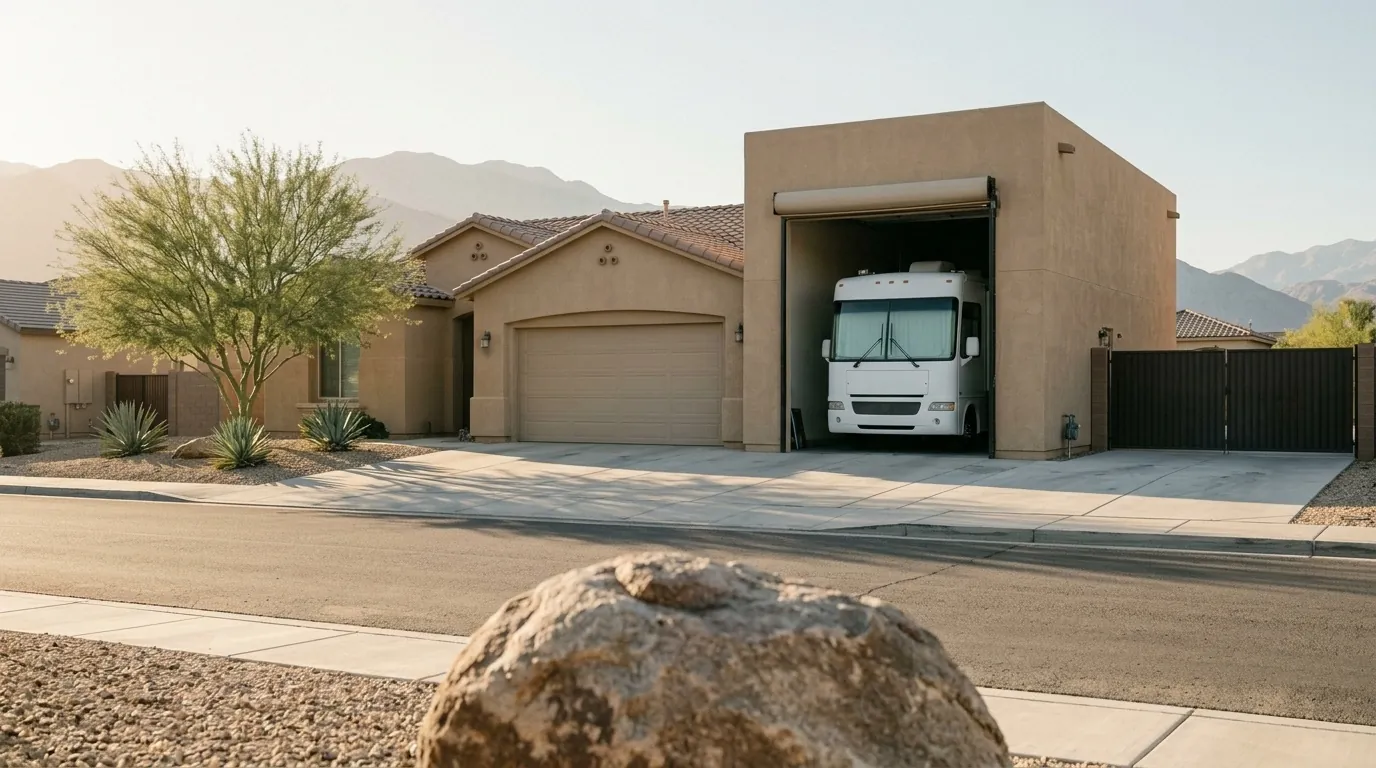
RV garage. A fully enclosed garage bay tall and deep enough for a motorhome, trailer or boat. It keeps the sun off, which in Las Vegas matters: our summers are hard on tires, roofs and seals. Some new-build plans now come with an RV-height bay.
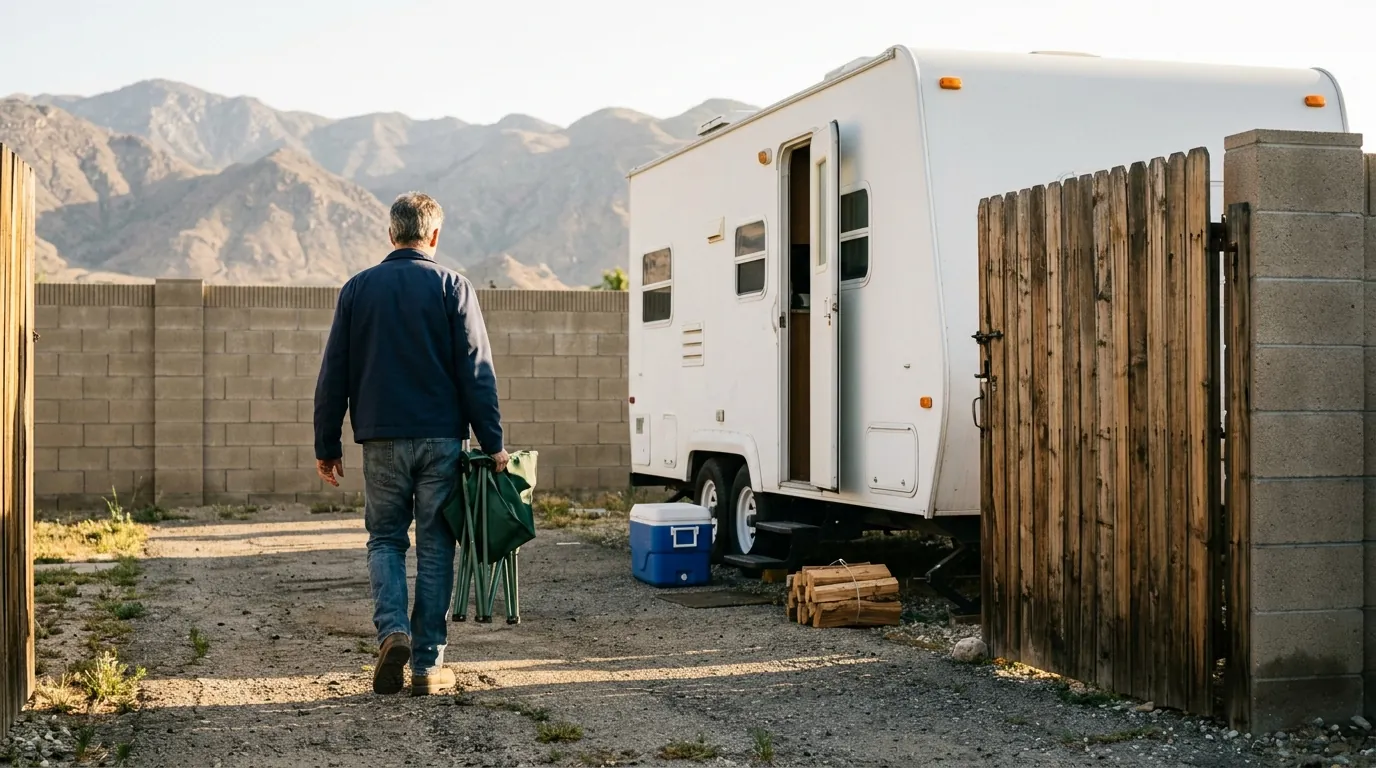
RV parking. A paved, paver or gravel pad on the lot, usually beside or behind the house, where the rig sits in the open. It might be behind a gate or right off the driveway.
RV gate. The gate in the side wall that gets you to the pad. A gate alone doesn't mean the space behind it works. We've seen RV gates that open onto a planter.
What to check on any RV setup
We won't quote you ideal sizes, because every rig is different. We walk through this list with your RV's actual measurements in hand:
- Gate width. Measure the clear opening with the gate open, post to post, and compare it to your rig's width plus mirrors.
- The turn in. A wide gate doesn't help if the street is narrow or a neighbor's car is always parked across from it. Stand in the street and picture the swing.
- The pad. What is it made of, how long is it and is it level? A pad that's short by four feet puts your bumper over the sidewalk.
- Height. For an RV garage, measure the door opening itself, not the ceiling. Lennar's site calls its bays "RV-height" and "RV-sized" but doesn't publish the door size, so ask the sales office for the door width and height in writing before you sign.
- Overhead. Eaves, trees, power lines and the patio cover next door.
- Power. Some RV pads and garages have a 30-amp or 50-amp outlet for keeping batteries and the fridge running. Ask what's there and have your inspector confirm it's wired and working. If it's missing, get an electrician's quote before you close.
- Water and a dump connection. Some owners add a hose bib and a sewer cleanout near the pad for dumping tanks. Ask if one exists and whether it was permitted.
- Slope and drainage. Monsoon storms send a lot of water down the side yard in a short time.
What the city and county allow
The northwest is part City of Las Vegas and part unincorporated Clark County, and the two have different codes. We check which one a parcel sits in before we tell you what you can do with it. This is what each code says, as we read it in September 2026. Codes change, so confirm the current version for your parcel.
City of Las Vegas
The city's Unified Development Code (Title 19, Chapter 19.12) spells out where an RV or trailer can sit when it isn't in a fully enclosed building:
- Rear yard: on pavers at least 2 inches thick, on decomposed granite at least 2 inches thick with borders, or on concrete, asphalt, gravel or chat that runs the full length and width of the vehicle.
- Side yard: screened from the street by a 6-foot wall with a 5-foot gate, or on pavers or concrete.
- Front yard: only on lots zoned R-E, R-D or R-1, on an approved surface. On lots of 0.2 acres or less, nothing over 24 feet can be parked in the front yard. The code also says the RV has to sit at least 2 feet from the street or sidewalk, or you have to show the side and rear yards aren't reasonably reachable. A block wall by itself doesn't count as "not reachable," and a corner lot is assumed to have access.
- No living in it. The RV can't be hooked up to electrical or sewer for more than 24 hours in a row, and it can't be used as a dwelling. The city's Code Enforcement FAQ puts it plainly: motor homes and trailers can't be connected to residential utilities or lived in unless they're in an RV park.
- Street parking: the city's Code Enforcement FAQ says it's unlawful to park a vehicle in the street for more than 72 consecutive hours.
You can read the city's version in its Code Enforcement questions sheet and the full code on the city's planning pages.
Unincorporated Clark County
The county's Title 30 development code treats RV, trailer and boat storage at a home as an accessory use in its residential districts. Two rules stand out: it has to go with a residence, and it's capped at three recreational vehicles. Title 30 also says a recreational vehicle can't be used as accessory living quarters. The county's code is posted on the Clark County planning department site.
HOA rules come on top
Zoning is the floor. Your HOA can be stricter, and in the master-planned communities it often is. Some CC&Rs allow RVs only inside a garage. Some allow a short window for loading and unloading, then the rig has to go. Some ban parking a trailer where neighbors can see it at all.
Read the rules before you fall in love with the house. On a resale home in an HOA, Nevada law (NRS 116.4109) gives you until midnight of the fifth calendar day after you receive the resale package to cancel, so we read the CC&Rs and the rules with you inside that window. On a new build, ask the sales office for the CC&Rs and design guidelines before you sign, not after.
This is one reason RV buyers end up on the big rural lots. Many of them have no HOA at all. See our page on horse property and acreage, where RV parking is usually the easy part.
Questions about buying out here? Call or text Michelle, or send a note and one of us will get back to you.
New homes with RV garages in Las Vegas
Yes, there are new homes in Las Vegas with RV garages, and some of the best-known are Lennar's.
In September 2026, lennar.com lists three plans with RV garages at Ann at The Estates, a community of single-story homes at 9556 W. Hammer Lane in 89149. All three pair the RV garage with Lennar's Next Gen suite, a private attached living space with its own entrance.
| Plan | Square feet | Beds / baths | Garage (Lennar's description) | From price |
|---|---|---|---|---|
| Leighton Next Gen w/ RV | 3,932 | 5 / 4.5 | 4-car, RV-sized | $1,094,990 |
| Kathryn Next Gen w/ RV | 4,240 | 5 / 4.5 | 4-car, RV-sized | $1,144,990 |
| Ganon Next Gen w/ RV | 4,237 | 6 / 4.5 | 6-car, RV-height | $1,234,990 |
Source: lennar.com, September 2026, subject to change. Lennar lists the HOA at about $95 a month for Ann at The Estates.
Lennar also built the Leighton and Ganon RV plans at The Montgomery in North Las Vegas. Lennar's site shows that community as sold out.
We cover these plans, and what to ask about them, on our Lennar NextGen page. Other builders in the northwest, including in Sunstone and Skye Canyon, change their plan options from phase to phase. When we tour a new community with you, the first question we ask is whether any lot or plan can take an RV garage or an RV gate, and what it costs. The answer isn't always on the brochure.
One tip on new builds: even without an RV garage, ask if your lot can take a side-yard RV gate and pad later. On a lot with a narrow side yard, or with the air conditioners on that side, the answer might be no. Better to know before you pick the lot.
Does an RV garage add value to a home?
It depends who's buying. Nobody publishes a clean number for it, and we won't make one up.
What we can tell you is how it plays out on the ground. An RV garage or a good gated pad doesn't raise the price of a home the way an extra bedroom does for every buyer. What it does is widen your pool of buyers to include the people who can't buy anything else. If you own an RV, a boat or a toy hauler, a home without a place to put it isn't really an option. Those buyers look hard for these homes, and when they find one that works, they tend to act.
The flip side: a buyer with no RV may see a big concrete pad as wasted yard. So the value shows up most when the RV setup is done well (paved, gated, with power) and when the rest of the house holds up on its own.
When we price an RV home to sell, we look at recent sales of homes with similar RV setups nearby, not the tract house next door with a two-car garage.
Where to store an RV if you can't park it at home
Plenty of great northwest homes simply can't take an RV. Maybe the HOA says no, or the side yard is 6 feet wide. You still have options:
- A commercial RV and boat storage lot. There are covered and uncovered lots around the valley. Visit before you sign: check the gate hours, the security, how far it is from your house and whether there's a dump station.
- A covered space if you can get one. Our sun is rough on RVs. Covered spots usually cost more, and they're worth asking about early.
- A friend with land. Out in the rural areas, it happens more than you'd think.
If storage is going to cost you every month, that's worth adding to the math when you compare a smaller lot to a home that has RV parking built in.
Frequently asked questions
Are there any new homes in Las Vegas that have an RV garage?
Yes. In September 2026, Lennar lists three single-story plans with RV garages at Ann at The Estates in northwest Las Vegas (89149): the Leighton, Kathryn and Ganon Next Gen w/ RV, from $1,094,990 on lennar.com. Other builders offer RV options on some lots and plans, so ask at each sales office.
Does an RV garage add value to a home?
It adds value for the right buyer. There's no reliable published figure, but an RV garage or gated RV pad brings in buyers who own RVs and boats and have few homes to choose from. It matters most when the setup is paved, gated and powered and the rest of the home is in good shape.
Where can I store my RV in Las Vegas?
At home if your zoning and HOA allow it, or at a commercial RV and boat storage lot. City of Las Vegas code allows RVs in rear yards and screened side yards on approved surfaces, with front-yard parking only on certain zoning. Check gate hours, security and covered options before you sign a storage contract.
Can you live in an RV in Las Vegas?
Not on a regular residential lot. The City of Las Vegas says a motor home or trailer can't be connected to residential utilities or lived in unless it's in an RV park, and Clark County's Title 30 says an RV can't be used as accessory living quarters. RV parks are the legal option for living full time in an RV.
Can I put a tiny home in my backyard in Las Vegas?
Sometimes, as a permitted casita or accessory living quarters, not as an RV. Both the city and the county have rules for a second living space on a residential lot, and they depend on the zoning, lot size and permits. We look up the parcel and send you to the right planning office before you buy with that plan in mind.
Tell us about your rig
Send us the length, the height and what you tow with. We'll start looking the same day. Call or text Michelle at 702-250-7224 or Marc at 702-768-9670.